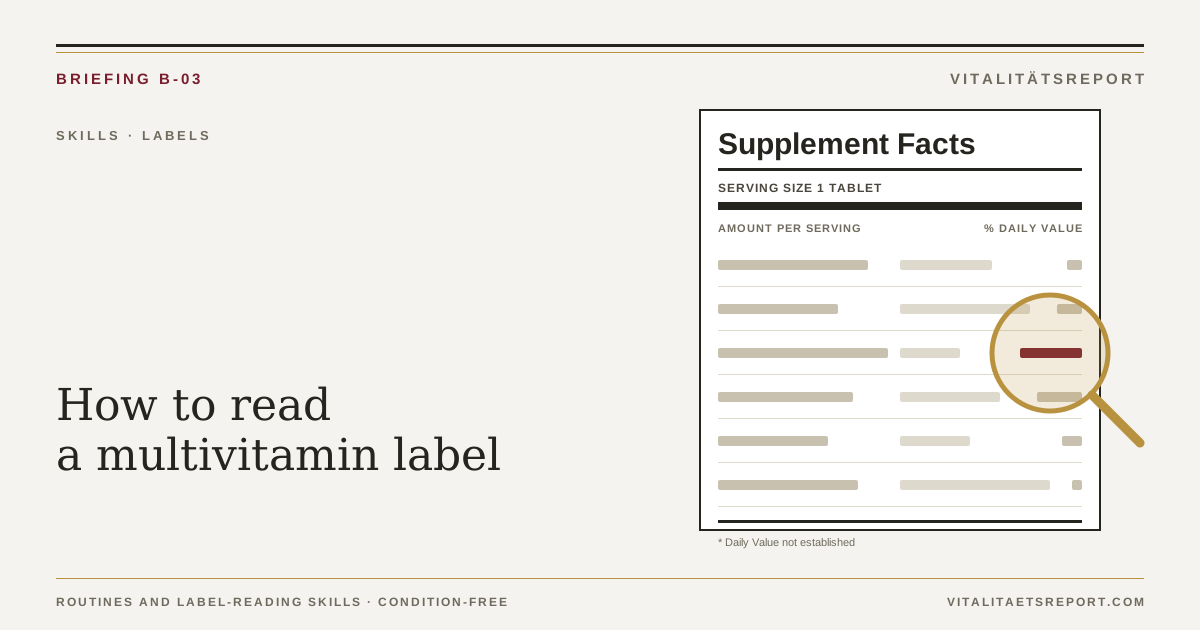
A multivitamin label is a small table with a lot of decisions hidden in it. This briefing walks the Supplement Facts panel from top to bottom, using the FDA's labeling rules as the grammar and the NIH Office of Dietary Supplements reference intakes as the yardstick, so that the next label you pick up reads like a document rather than a list of promises.
First, what a "multivitamin" is, and is not
There is no legal definition. The NIH Office of Dietary Supplements (ODS) states that multivitamin/mineral products "have no standard or regulatory definition, such as what nutrients they must contain or in what amounts," and that manufacturers decide the combinations and levels. Roughly one-third of U.S. adults take one. The ODS sorts them into three kinds, and the sorting is the first thing to do with any bottle: a basic once-a-day product with most nutrients at or below the Daily Value or recommended intake; a high-dose product (the ODS's second group) with some amounts "substantially higher" than the recommended intake or even the upper limit, sometimes split across two or more pills a day; and a specialized product, sold for energy, eyes or other purposes, that adds botanicals and specialty ingredients such as coenzyme Q10 or probiotics, sometimes also above the upper limit.
Two facts from the FDA frame everything else. Manufacturers are responsible for evaluating the safety and labeling of their products before marketing them, and the FDA's authority is to act against an adulterated or misbranded product after it reaches the market. And every label must carry five things: a statement of identity, a net quantity, the nutrition labeling (the Supplement Facts panel), an ingredient list, and the name and place of the business behind it.
Start with the serving size
Every number in the panel is "per serving," and the FDA's labeling guide defines the serving as the maximum amount the label recommends per eating occasion. The guide also allows the column to be headed "Amount per 2 tablets" or "Each tablet contains" instead of "Amount per serving," so read the heading, not just the numbers. Three consequences follow. If the serving is two tablets and you take one, halve everything below. If the serving is two tablets, a 60-count bottle is a 30-day supply, whatever the front of the box implies. And a product that reaches its impressive percentages only across three or four pills a day belongs in the ODS's high-dose group, which is worth knowing before you compare it with a one-a-day.
Read the directions line at the same time. "Take with food" is not decoration: the ODS notes that fat in the gut improves the absorption of vitamin D.
% Daily Value, and what changed in 2020
The FDA's Daily Values (DVs) are "the recommended amounts of nutrients to consume or not to exceed each day," and the % Daily Value tells you what share of that amount one serving supplies. The agency's rule of thumb is that 5 percent or less is low and 20 percent or more is high. A multivitamin usually reads 100 percent for a long list of nutrients, which is exactly what a basic product should do.
The labels changed under an FDA rule that manufacturers with $10 million or more in annual sales had to meet by January 1, 2020, and smaller ones by January 1, 2021. Three changes still confuse comparisons with older bottles and older articles. Several DVs were updated to newer science, vitamin D among them. On the food label, vitamin D and potassium became required entries while vitamins A and C became voluntary; on a multivitamin's Supplement Facts panel, the vitamins and minerals the product actually contains are still listed, so the practical change there is in the numbers and units. Five units changed: vitamins A and D moved from International Units to micrograms, vitamin E to milligrams, niacin to milligrams of niacin equivalents, and folate to micrograms of dietary folate equivalents (mcg DFE), with any folic acid content listed in parentheses. An IU figure in parentheses after the microgram amount, as in "50 mcg (2,000 IU)," is a familiar courtesy; a label that gives vitamin D only in IU, with no microgram figure, is most likely older stock.
The current DVs for adults and children four and older include vitamin A 900 mcg RAE, vitamin C 90 mg, vitamin D 20 mcg (800 IU), vitamin E 15 mg, vitamin B6 1.7 mg, folate 400 mcg DFE, vitamin B12 2.4 mcg, calcium 1,300 mg, iron 18 mg, magnesium 420 mg and zinc 11 mg.
A Daily Value is one number for everyone aged four and up. The NIH recommended intakes are set by age and sex, and after 50 they diverge from the label in both directions. That is why "100 percent" on a 50+ formula still needs a second look.
The table below puts the label figure next to the NIH recommended intake for adults 51 and older and the adult upper limit, for the nutrients where the gap matters most.
| Nutrient | DV on the label | NIH RDA, adults 51+ | Upper limit, adults |
|---|---|---|---|
| Vitamin D | 20 mcg (800 IU) | 15 mcg (600 IU) through age 70; 20 mcg (800 IU) after 70 | 100 mcg (4,000 IU) |
| Vitamin B6 | 1.7 mg | 1.7 mg men; 1.5 mg women | 100 mg |
| Vitamin B12 | 2.4 mcg | 2.4 mcg | None set; absorption falls sharply at high doses |
| Magnesium | 420 mg | 420 mg men; 320 mg women | 350 mg from supplements and medicines only (food not counted) |
The form in parentheses
The FDA lets a label name the chemical form after the nutrient, "vitamin C (ascorbic acid)" for example, and most multivitamins do. The parentheses matter in a few places and are marketing in most others.
Vitamin D appears as D2 (ergocalciferol) or D3 (cholecalciferol); the ODS says both forms are well absorbed. Vitamin B12 is most often cyanocobalamin, with methylcobalamin and other forms on pricier labels; the ODS finds no evidence that absorption differs by form. Folate is the case where the parentheses carry real information: the % Daily Value is shown for total folate, and any folic acid is listed in micrograms inside the parentheses, because the body absorbs folic acid more readily than food folate. Magnesium is the case where the number itself is the point: the Supplement Facts panel must declare elemental magnesium, not the weight of the whole compound, and the ODS notes that in small studies the aspartate, citrate, lactate and chloride forms were absorbed more completely than oxide or sulfate. Briefing B-04 goes deeper on that one mineral.
Proprietary blends and the asterisk
Two features of the panel hide information legally. A "Proprietary Blend" must show the total weight of the blend and list its ingredients in descending order by weight, but under the FDA's rules the individual amounts need not be declared. That means you cannot compare any ingredient in the blend with a recommended intake or an upper limit, which is the whole point of reading a label. On a basic multivitamin a blend is usually a small line of fruit powders; on a specialized product it can be where most of the marketing lives.
The asterisk is the second feature. When an ingredient has no Daily Value, the panel shows a symbol in the % column that points to the footnote "Daily Value not established." The FDA has simply set no reference amount for it. Lutein, coenzyme Q10, most botanicals and many "specialty" ingredients sit under that footnote, and it means neither that they are useless nor that they are useful; it means the label cannot tell you how the amount compares with anything.
What a 50+ formula changes, and the numbers that deserve a second look
The ODS describes what "senior" or "50+" formulas typically do: they often contain little or no iron, and more calcium, vitamin D and vitamin B12 than products for younger adults. The reasoning is sound. Older adults are at higher risk of running low in vitamin D, partly because the skin's ability to make it declines with age, and older adults are among the groups most likely to be low in B12, partly because the vitamin in food must first be freed by stomach acid, whereas the B12 in supplements and fortified foods is already in free form. The ODS also notes that multivitamins typically carry 5 to 25 mcg of B12 (some 50+ formulas carry several times that), that absorption is only about 2 percent at a 500 mcg dose, and that no upper limit has been set for it.
The second look is for the other direction, and it is where the ODS's safety language matters. Taking a basic product near recommended intakes "should be safe for healthy people," but "individuals who take MVMs and other supplements and who consume fortified foods and beverages might obtain some nutrients in amounts exceeding the UL." So, on a 50+ label, read these lines against the table above and against everything else you take:
- Vitamin B6. The adult upper limit is 100 mg a day, set by the Food and Nutrition Board at half the average dose used in long-term studies, to stay clear of the nerve-related side effects reported at higher doses. Some "energy" and 50+ formulas run into the tens of milligrams; add a B-complex and the total climbs.
- Vitamin D. The upper limit is 100 mcg (4,000 IU). Some 50+ multis already carry 50 mcg (the one in Report R-01 does); add a separate 50 mcg D3 softgel and you are at the limit before fortified milk and cereal. The ODS reports that in 2013–2014 about 3 percent of U.S. adults were already taking 100 mcg or more from supplements alone.
- Magnesium. The upper limit of 350 mg applies to supplements and medicines, not food. Multivitamins usually carry well under that figure, so the number to watch is a separate magnesium product on top.
- Folic acid. The ODS cites an upper limit of 1,000 mcg a day for folic acid from supplements and fortified foods, and notes that some prenatal products reach it on their own.
- Vitamin A and beta-carotene. The ODS advises smokers, and possibly former smokers, to avoid products providing large amounts of beta-carotene or vitamin A, on the strength of two large trials.
- Iron. A 50+ formula with little or no iron is usually deliberate, not a defect. If a label aimed at adults over 50 still carries 18 mg, ask why.
Overlap, not any single bottle, is the usual way a healthy adult exceeds an upper limit. Write down every supplement you take and every fortified food you eat daily, then add the columns. Bring the list to your clinician, and mention it before any blood test.
Claims, disclaimers and seals
Below the panel come the words. A phrase such as "supports energy metabolism" or "helps maintain bone" is what the FDA calls a structure/function claim: it may describe the role of a nutrient in the body, it may not describe a relationship to any disease, and it must be accompanied by the FDA's standard two-sentence disclaimer, the familiar text stating that the claim has not been evaluated by the agency and that the product is not intended to diagnose, treat or prevent any disease. The manufacturer notifies the FDA within 30 days of first marketing such a claim; the agency does not approve it in advance. Read the claims as the seller's words, and read the panel as the facts.
Seals are the last line. A third-party mark such as USP Verified speaks, in our reading, to whether the product contains what the label says and was made under proper controls; no seal tests whether the product does anything for you. Two habits keep this honest. Confirm any seal in the certifier's own public directory rather than trusting the artwork, and do not mistake a description for a seal: "made in a GMP facility" describes a legal requirement that applies to every manufacturer, and "third-party tested" without a named program is a phrase, not a certification. Report R-01 applies all of this to one popular 50+ label, and Report R-02 and Report R-03 show what happens to the vitamin D and B6 columns when a single-nutrient product is added on top.
Sources
- National Institutes of Health, Office of Dietary Supplements. Multivitamin/mineral supplements fact sheet for health professionals. link
- U.S. Food and Drug Administration. Dietary supplements: overview of the agency's role and manufacturers' responsibilities. link
- U.S. Food and Drug Administration. Dietary Supplement Labeling Guide, Chapter I: general labeling (five required label statements). link
- U.S. Food and Drug Administration. Dietary Supplement Labeling Guide, Chapter IV: nutrition labeling (serving size, amount per serving, % Daily Value, proprietary blends, "Daily Value not established"). link
- U.S. Food and Drug Administration. Dietary Supplement Labeling Guide, Chapter VI: claims (structure/function claims, the required disclaimer, 30-day notification). link
- U.S. Food and Drug Administration. Daily Value on the Nutrition and Supplement Facts labels (definition, % DV, 5 percent and 20 percent rule, current DV table). link
- U.S. Food and Drug Administration. Changes to the Nutrition Facts label (compliance dates, updated DVs, required and voluntary nutrients). link
- U.S. Food and Drug Administration. Constituent update, August 2019: guidance to convert units of measure for folate, niacin and vitamins A, D and E on Nutrition and Supplement Facts labels. link
- U.S. Food and Drug Administration. Folate and folic acid on the Nutrition and Supplement Facts labels (mcg DFE, folic acid in parentheses). link
- National Institutes of Health, Office of Dietary Supplements. Vitamin D fact sheet for health professionals (RDA and UL tables, absorption with fat, older adults). link
- National Institutes of Health, Office of Dietary Supplements. Vitamin B6 fact sheet for health professionals (RDA table, 100 mg upper limit). link
- National Institutes of Health, Office of Dietary Supplements. Vitamin B12 fact sheet for health professionals (RDA, forms, absorption at high doses, older adults). link
- National Institutes of Health, Office of Dietary Supplements. Magnesium fact sheet for health professionals (RDA table, supplemental UL, elemental declaration, forms). link
This briefing is educational and is not medical advice. Ask a qualified clinician before changing a routine or starting any supplement.