Two bottles on the same shelf can both say "magnesium 500 mg" and deliver very different amounts of the mineral, because one number describes the whole compound and the other describes the magnesium inside it. Read that difference and the rest is simple: the form decides how much of the tablet is magnesium, how well it dissolves, and how likely it is to loosen your stools. This briefing walks through the three forms you will meet most often, what the small human studies actually measured, and the two numbers to keep in your head when you read a label.
Same mineral, different companion
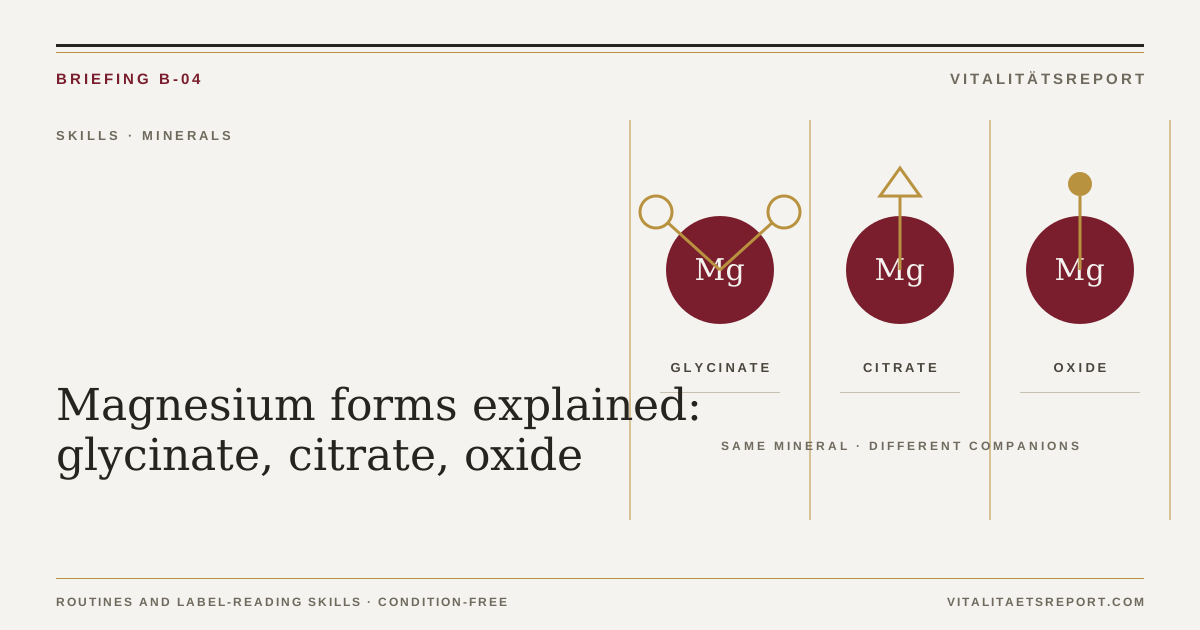
Magnesium never sits in a tablet on its own. It is always bound to a partner: an oxygen atom in magnesium oxide, citric acid in magnesium citrate, or two molecules of the amino acid glycine in magnesium glycinate (often labeled bisglycinate, and called a chelate because the glycine wraps around the metal). The magnesium ion your body uses is the same in all three. What changes is the weight of the partner, how the pair behaves in water and stomach acid, and how much of the dose reaches the bloodstream rather than staying in the gut.
Elemental weight versus compound weight
US labeling rules settle the first question, if you know where to look. The FDA's dietary supplement labeling guide is explicit that the Supplement Facts panel must list the weight of the nutrient itself, not of the source ingredient; its own example is that a label must declare the weight of calcium, not the weight of the calcium carbonate it came from. The same applies to magnesium. The line "Magnesium (as magnesium bisglycinate) 200 mg" means 200 mg of elemental magnesium. The trouble starts on the front of the bottle, where a claim like "Magnesium Glycinate 1,000 mg" describes the compound.
How far apart the two numbers sit depends on the partner's weight, and that is plain chemistry. Using the molecular weights recorded in PubChem: magnesium oxide is about 60 percent magnesium by weight, because oxygen is light; magnesium bisglycinate is about 14 percent, because two glycine molecules are heavy; and the anhydrous trimagnesium citrate salt is about 16 percent, with hydrated or differently proportioned citrate salts lower still. In practice a 500 mg tablet of magnesium oxide carries roughly 300 mg of magnesium, while 500 mg of magnesium glycinate carries roughly 70 mg. This is why glycinate products need two or three sizeable tablets to reach a couple of hundred milligrams.
The number that matters is the one in the Supplement Facts panel next to the word "Magnesium," with the form in parentheses. That figure is elemental magnesium per serving, by law. A larger number on the front of the bottle is usually the weight of the whole compound.
Oxide: the most magnesium per tablet, the least absorbed
Magnesium oxide is the cheapest form and the most concentrated. Its weakness is solubility. A 1990 study in the Journal of the American College of Nutrition found magnesium oxide virtually insoluble in water and only 43 percent soluble in a solution simulating peak stomach acid, and after a single dose the citrate form produced far more magnesium in the urine over the following hours. A 2001 study of four US commercial preparations put the fractional absorption of magnesium oxide at about 4 percent, significantly below magnesium chloride, lactate and aspartate. A 2003 randomized, double-blind study gave 46 healthy adults 300 mg of elemental magnesium a day as citrate, an amino-acid chelate or oxide for 60 days; the two organic forms were absorbed better than oxide, and on the study's measures the oxide group did not differ from placebo. In a 2019 study of 14 men whose magnesium stores had first been topped up, a single dose of citrate raised 24-hour urinary magnesium significantly while oxide did not. These are small studies with indirect measures such as urine and blood, so treat the percentages loosely, but they point the same way.
The flip side is the laxative effect. Magnesium that is not absorbed stays in the gut and draws water in; that is the mechanism magnesium laxatives rely on. With oxide, more of each dose stays behind, so a large dose is more likely to produce loose stools.
Citrate: better absorbed, and sold as a laxative in its own right
Magnesium citrate dissolves far more readily than oxide (in the 1990 study 55 percent of it dissolved even in plain water, and it was more soluble than oxide at every level of acid tested), and in the 2003 comparison it produced the largest rise in blood magnesium after both a single dose and 60 days. It is also, plainly, a laxative at the right dose. A magnesium citrate oral solution sold over the counter in US pharmacies lists its purpose on the Drug Facts panel as "saline laxative," contains 1.745 g of magnesium citrate per fluid ounce, and states that it generally produces a bowel movement in half an hour to six hours. A supplement capsule delivers a fraction of that, and most people notice nothing, but anyone whose digestion already runs quick may find that a single larger dose on an empty stomach moves things along more than they wanted. The same label carries two lines worth borrowing for any magnesium product: do not use it with reduced kidney function or on a magnesium-restricted diet without a doctor's say-so, and take it two or more hours before or after other medicines.
Glycinate: the gentle reputation, and how thin the evidence behind it is
Magnesium glycinate is the form most often described as easy on the stomach, and the description is plausible: the glycine partner is absorbed by its own route, and less unabsorbed magnesium in the gut means less water drawn in. The evidence, though, is thinner than the reputation. The one direct human comparison we could find is a 1994 double-blind crossover trial in 12 patients who had part of the small intestine surgically removed; across the whole group, absorption of a 100 mg dose did not differ between magnesium diglycinate and oxide (23.5 versus 22.8 percent), though the diglycinate was absorbed substantially better in the four patients with the most impaired absorption (23.5 versus 11.8 percent) and was better tolerated. That is a specialized group, not healthy adults. The 2003 study's amino-acid chelate arm outperformed oxide but was edged by citrate. A 2017 review in Current Nutrition and Food Science summed the field up honestly: some studies show a slightly higher bioavailability for organic forms, others do not, and it remains unclear which form produces the highest bioavailability. If glycinate suits you, that is a good reason to use it; a claim that it is proven superior is not one the literature supports.
Two consequences of glycinate's low magnesium content are practical rather than scientific. The tablets are large or numerous, so check how many make a serving and do the arithmetic on the bottle count. And because each tablet delivers modest magnesium, it is harder to overshoot the upper limit by accident than with a concentrated oxide product.
How to read the magnesium amount on any label
Use the same steps every time and the front of the bottle stops mattering.
- Turn the bottle to the Supplement Facts panel and read the serving size, including how many tablets or capsules it is. Every number that follows is per serving, not per tablet.
- Find the line that begins "Magnesium" and note the form in parentheses. The milligram figure on that line is elemental magnesium per serving under FDA rules; a bigger number on the front is almost certainly the compound weight.
- Read the percent Daily Value next to it. The FDA's Daily Value for magnesium is 420 mg, and its rule of thumb is that 20 percent or more per serving counts as high, 5 percent or less as low.
- Add up everything else you take that contains magnesium: a multivitamin, an antacid, a laxative, a "calcium-magnesium" bone formula. It is the total from supplements and medicines, not from food, that is measured against the 350 mg limit in the next section.
- Read "Other ingredients" for fillers, coatings and allergens, and check that the count on the bottle divided by tablets per serving gives the number of days the seller claims.
The two numbers to remember
The first number is what a body needs. The Recommended Dietary Allowance for magnesium, as listed by the NIH's MedlinePlus, is 400 mg a day for men aged 19 to 30 and 420 mg from 31 onward; for women it is 310 mg from 19 to 30 and 320 mg from 31 onward. That figure is meant to come mostly from food: leafy greens, nuts such as almonds and cashews, beans, seeds, whole grains, soy foods and milk are the sources MedlinePlus lists, and the NIH Office of Dietary Supplements notes that only about 30 to 40 percent of dietary magnesium is typically absorbed.
The second number is the ceiling for supplements. In 1997 the Institute of Medicine set a tolerable upper intake level for adults of 350 mg a day from supplemental magnesium alone, after noting that several studies had reported gut disturbances such as cramping and diarrhea at higher supplemental doses; the same committee found no reports of harm from magnesium occurring naturally in food, which is why the limit does not count what you eat. A 2023 perspective article in Advances in Nutrition argues that the limit is conservative and should be re-evaluated, but until any such review happens, 350 mg from supplements is the published figure and the one to read a label against. Two practical points come from the absorption research: the fraction absorbed falls as the dose rises (the 2017 review cites about 65 percent absorbed at a tiny 36 mg daily intake against about 11 percent at 973 mg), and a dose split across the day is absorbed better than one large dose.
Magnesium leaves the body through the kidneys. In healthy people they clear an excess efficiently; MedlinePlus notes that side effects from high magnesium intake are uncommon except in people with significantly reduced kidney function. If your kidney function is reduced, or you do not know, ask your clinician before taking any magnesium supplement, whatever the form.
Medicines and timing
Magnesium binds to some medicines in the gut and stops them being absorbed. The prescribing information for ciprofloxacin tablets, a common antibiotic, tells patients to take the tablet at least two hours before or six hours after magnesium or aluminum antacids and other products containing magnesium, calcium, iron or zinc, and that pattern applies to several other medicines besides. The over-the-counter magnesium citrate label puts the general rule more simply: take it two or more hours before or after other drugs, because laxatives may affect how other drugs work. If you take any regular medicine, ask a pharmacist to check your list against a magnesium supplement before you start. The answer is usually hours apart rather than a reason not to take it.
Where the sleep claims fit
Magnesium is sold on sleep more than on anything else. A 2021 systematic review in BMC Complementary Medicine and Therapies of magnesium supplements and sleep in older adults found only three randomized trials, with 151 participants between them; people taking magnesium fell asleep about 17 minutes sooner than those on placebo, and the authors rated the evidence low to very low quality. That is a small, uncertain effect, and it says nothing about which form was used. If you are weighing a magnesium product for the evening, Report R-06 reads a glycinate label line by line, Report R-07 covers the other supplement most often sold for the same purpose, and Briefing B-02 sets out the evening routine the research supports before either.
Sources
- MedlinePlus Medical Encyclopedia (NIH, National Library of Medicine). Magnesium in diet: Recommended Dietary Allowances by age and sex, food sources, and side effects in reduced kidney function. Reviewed January 21, 2025. link
- Advances in Nutrition, 2023. Perspective article on the Institute of Medicine's 1997 tolerable upper intake level of 350 mg/day for supplemental magnesium, its basis and the case for re-evaluating it. PubMed Central PMC10509448. link
- US Food and Drug Administration. Dietary Supplement Labeling Guide, Chapter IV: Nutrition labeling (declaring the weight of the nutrient, not the source compound). April 2005. link
- US Food and Drug Administration. Daily Value on the Nutrition and Supplement Facts labels: magnesium 420 mg; the 5% / 20% rule of thumb. Current as of March 5, 2024. link
- PubChem (NIH, National Library of Medicine). Compound records with molecular weights: magnesium oxide (CID 14792), magnesium bisglycinate (CID 84645), trimagnesium dicitrate (CID 6099959). oxide, bisglycinate, citrate
- Journal of the American College of Nutrition, 1990;9(1):48–55. Solubility and urinary-excretion comparison of magnesium citrate and magnesium oxide. PubMed 2407766. link
- Magnesium Research, 2001;14(4):257–262. Bioavailability of four US commercial magnesium preparations (oxide, chloride, lactate, aspartate). PubMed 11794633. link
- Magnesium Research, 2003;16(3):183–191. Randomized, double-blind comparison of magnesium citrate, amino-acid chelate and oxide at 300 mg elemental magnesium a day in 46 adults over 60 days. PubMed 14596323. link
- Magnesium Research, 2019;32(3):63–71. Urinary and plasma magnesium after single doses of citrate and oxide in 14 magnesium-replete men. PubMed 32162607. link
- JPEN Journal of Parenteral and Enteral Nutrition, 1994;18(5):430–435. Double-blind crossover comparison of magnesium diglycinate and magnesium oxide absorption in 12 patients after intestinal surgery. PubMed 7815675. link
- Current Nutrition and Food Science, 2017;13(4):260–278. Review of intestinal absorption and factors influencing magnesium bioavailability, including dose dependence and organic versus inorganic forms. PubMed Central PMC5652077. link
- DailyMed (NIH, National Library of Medicine). Drug Facts label for an over-the-counter magnesium citrate oral solution (saline laxative): active ingredient, purpose, timing, kidney and medicine-spacing warnings. link
- DailyMed (NIH, National Library of Medicine). Prescribing information for ciprofloxacin tablets: dosing relative to magnesium-containing products. Revised September 2020. link
- BMC Complementary Medicine and Therapies, 2021. Systematic review and meta-analysis of oral magnesium supplementation and sleep in older adults: three trials, 151 participants. PubMed 33865376. link
- National Institutes of Health, Office of Dietary Supplements. Magnesium fact sheet for health professionals (share of dietary magnesium absorbed, forms, upper limit). link
This briefing is educational and is not medical advice. Ask a qualified clinician before changing a routine or starting any supplement.